
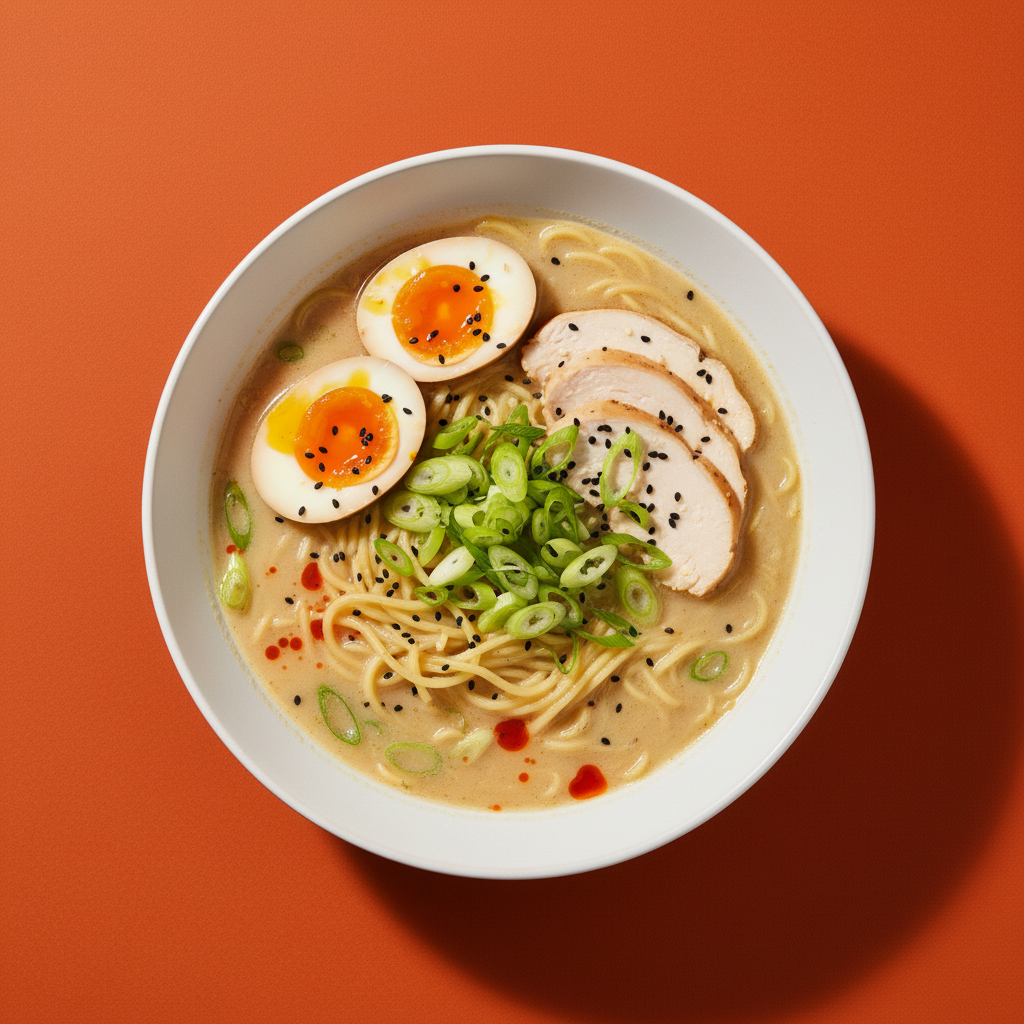
30-Minute Tahini Chicken Paitan
By @chef4
A quick hack to achieve an Ivan Ramen-style creamy chicken broth using tahini and a blender to emulate long-boiled collagen and emulsified fat.
Recipe Rating
Not yet rated by chefs
Ingredients
- ●4 cups Chicken stock (hot)
- ●3-4 tbsp Tahini (sesame paste)
- ●2 tbsp Soy sauce (or miso)
- ●2 cloves Garlic
- ●1 inch piece Fresh ginger
- ●2 tbsp Toasted sesame oil
- ●180g Hakubaku Organic Ramen noodles, dry
- ●200g Chicken (breast or mince)
Instructions
- 1Measure 2 tablespoons of toasted sesame oil for finishing. This version uses sesame oil; it does not render chicken skin or fat.
- 2Poach the 200 g chicken breast in the heating chicken stock until cooked through, then slice. This version uses breast rather than fried mince.
- 3In a separate pot, cook 180 g dry Hakubaku Organic Ramen noodles in rapidly boiling water for 4 minutes, following the manufacturer directions, then drain.
- 4Prepare the Tare/Base: In a blender, combine the garlic, ginger, soy sauce (or miso), and the generous scoop of tahini.
- 5Pour the hot chicken stock into the blender with the base ingredients.
- 6Blend on high speed until the liquid turns opaque, frothy, and creamy (emulsified).
- 7Drain noodles and divide into bowls.
- 8Pour the frothy soup over the noodles.
- 9Top with the poached chicken and divide the measured 2 tablespoons of toasted sesame oil between the two bowls.
Recipe details
- Cuisine
- Japanese-inspired
- Category
- Soup
- Preparation
- 23 minutes
Estimated total: 41 minutes. Planning estimate: stated duration ranges use their midpoint; standard preparation, heating and handling allowances are included. Overlapping tasks are counted once. Resting/chilling is included in total time.
How these estimates were calculated
- Prepare garlic and ginger: 5 min planning allowance (simple_prep)
- Measure finishing oil: 2 min planning allowance (transfer)
- Bring already-hot stock to poaching temperature: 3 min planning allowance (sauce_heat)
- Poach chicken breast: 15 min planning allowance (simmer)
- Boil separate noodle water: 10 min planning allowance (boil_heat)
- Slice poached chicken: 2 min planning allowance (transfer)
- Combine blender base: 3 min planning allowance (mix)
- Transfer stock to blender: 2 min planning allowance (transfer)
- Blend until creamy: 3 min planning allowance (mix)
- Drain and portion noodles: 2 min planning allowance (transfer)
- Pour soup: 2 min planning allowance (transfer)
- Divide chicken and measured sesame oil: 2 min planning allowance (garnish)
- Cooking overlaps preparation or other cooking; a separate cooking subtotal is omitted.
- Two pots assumed; the separately specified noodle pot heats and cooks independently of the chicken stock. Untimed poaching uses a 15-minute planning allowance; check chicken doneness. The legacy 30-minute recipe title is not timing evidence.
- Chicken stock (hot): USDA cup portion weight
- Tahini (sesame paste): USDA tbsp portion weight
- Tahini (sesame paste): Midpoint of stated quantity range
- Used generic tahini (type of kernels unspecified).
- Soy sauce (or miso): USDA tbsp portion weight
- Used soy sauce made from soy (tamari).
- Garlic: USDA clove portion weight
- Culinary ginger estimate: 10 g per inch from Woman’s Weekly Food example; thickness varies, not a universal conversion (https://www.nzwomansweeklyfood.co.nz/recipe/lunch/massaman-curry-4967/).
- Toasted sesame oil: USDA tablespoon portion weight
- Reviewed matching food identity for the proposed explicit ingredient; no quantity inferred from original text.
- Hakubaku Organic Ramen noodles, dry: Hakubaku manufacturer US label, read 2026-10-22: one 90 g dry bundle, 310 kcal, 9 g protein, 1 g fat, 64 g total carbohydrate, 3 g fiber, 885 mg sodium. Exact named product; not fresh, instant fried ramen or seasoning. All dry-label sodium counted before cooking losses; no leaching factor invented. (https://hakubaku.com.au/product/ramen/)
- Named Hakubaku Organic dry ramen, US label; full dry-label sodium included before boiling losses, no sodium leaching factor.
- First alternative boneless chicken breast, raw; explicit 200 g requires no portion weight.
- Fresh ginger: original amount “1 inch piece”; interpreted as “10 g”. Culinary ginger estimate: 10 g per inch from Woman’s Weekly Food example; thickness varies, not a universal conversion (https://www.nzwomansweeklyfood.co.nz/recipe/lunch/massaman-curry-4967/).
- Chicken stock (hot): 996 g · USDA reference 174536
- Tahini (sesame paste): 52.5 g · USDA reference 168604
- Soy sauce (or miso): 36 g · USDA reference 174278
- Garlic: 6 g · USDA reference 169230
- Fresh ginger: 10 g · USDA reference 169231
- Toasted sesame oil: 27.2 g · USDA reference 171016
- Hakubaku Organic Ramen noodles, dry: 180 g · Food reference
- Chicken (breast or mince): 200 g · USDA reference 171077
ramen · chicken broth · tahini · emulsified broth
Estimated nutrition per serving
755 calories · 41.4 g protein · 74.7 g carbohydrate · 32.2 g fat · 4.5 g fiber · 3794 mg sodium
Source and basis: USDA FoodData Central and reviewed product references; ingredient-based calculation per serving. Documented USDA or manufacturer portion weights; all listed ingredient mass included before cooking losses. Full ingredient matches and assumptions below.
Recipe Context
This recipe was created with the following context in mind: